
A few years ago, I coached a business owner who was navigating what she later described as “the hardest season of my life.”
In the thick of major professional upheaval and relentless stress, she took the EQ-i 2.0 assessment, a tool that measures emotional intelligence across 15 subscales.
At the time, her results reflected exactly what she was living through: low stress tolerance, impulse control challenges, and imbalances between emotional awareness, empathy, and decision-making.
Fast forward four years.
This week, we revisited her EQ-i results together. Not to rehash old wounds but to reflect.
With time, perspective, and experience, we used her original profile as a jumping-off point to examine how she’s grown and what tools are now helping her stay steady in a very different season of life.
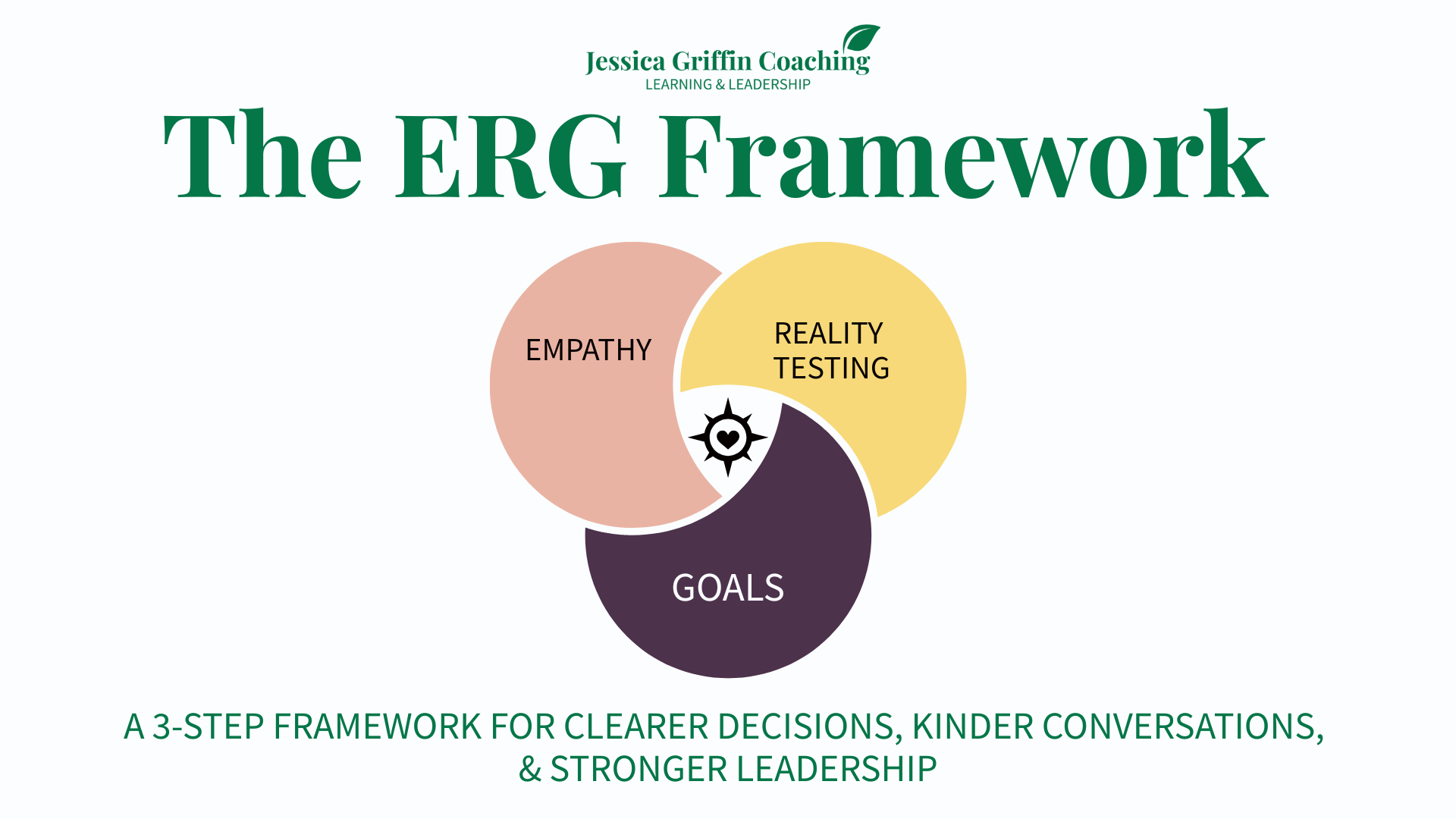
One of the strategies we explored is what I call the ERG: Empathy–Reality Testing–Goal Setting Framework—a way to lead with both heart and discernment.
Whether you’re navigating team conflict, managing performance conversations, or spiraling in self-doubt after a tough day, this simple three-step lens can help.
The Empathy–Reality Testing–Goal Setting Framework
Step 1: Empathy
“What might be true for this person? What is true for me? What’s a generous, emotionally intelligent interpretation of our behaviors or perspectives?”
This is where we hold space. For others, for ourselves, for the messiness of being human.
Starting with empathy doesn’t mean we excuse poor performance or ignore our own needs, it means we lead from understanding instead of assumption.
Step 2: Reality Testing
“What do I know to be true? What patterns, facts, or needs can ground this conversation or decision?”
Here, we bring clarity. Reality testing is a powerful EQ subscales because it helps us assess situations based on data, not drama.
It’s especially useful when we feel emotionally flooded or stuck in stories about how others see us.
Step 3: Goal Setting
“Given what’s real and what matters, what’s a values-aligned next step?”
From this balanced place, we can co-create clear goals, whether that’s with a team member, a partner, or just within ourselves.
The goals don’t have to be seismic. Sometimes the win is a small shift in language, a gentle boundary, or a decision not to escalate.
How You Can Use The ERG Framework
You don’t need to take the EQ-i 2.0 (though I happen to think it’s an incredibly insightful tool) to start practicing this framework. Try applying it in one of these ways:
- Self-Journaling after a stressful situation: What’s the most generous interpretation? What’s real? What’s a small next step I can take?
- Performance Conversations with a team member: Start by naming what you notice and appreciate (empathy), share the data or pattern that needs attention (reality), and co-create a next step (goal).
- Strategic Planning as a leader: Use empathy to understand the emotional climate of your team or customers, ground your decisions in evidence and experience, and then create aligned, measurable goals.
The ERG Framework in Practice: Performance Conversations
Let’s explore how this framework can be applied in a leadership context using a relatable, composite example from the kinds of conversations many leaders and business owners navigate.
The Situation:
You’re the owner of a small business, and one of your team members recently requested a new professional development opportunity that comes with a significant cost.
You’ve already invested in similar training in the past, but haven’t seen consistent implementation or results.
Meanwhile, revenue has dipped due to seasonal fluctuations, and you’re trying to balance financial sustainability with team support and growth.
Step 1: Empathy
“What might be true for this person? What is true for me?”
Instead of reacting with frustration or brushing off the request, you take a moment to consider where your team member is coming from. You recognize their genuine desire to improve and contribute to the business, and you acknowledge your own stress and concern about resources and timing.
Conversation example:
“I really appreciate how invested you are in developing your skills. I know you’re committed to our success, and I can see why this training feels like a valuable next step.
I also want to be honest that I’m feeling some pressure right now about our financial position, especially after our recent investment in similar development.”
Step 2: Reality Testing
“What do I know to be true?”
You ground yourself in the data.
Sales are currently lower than projected. The last training hasn’t been fully integrated into day-to-day operations.
You also know this person thrives with support and structure, and that you’ve seen flashes of strong performance when they’re focused.
Conversation example:
“Looking at where we’re at, I know we’re entering a slower season financially. And while we’ve made progress, we haven’t yet implemented the full toolkit from the last training.
I also know that when you have a clear structure and accountability, you tend to really shine.”
Step 3: Goal Setting
“What’s a values-aligned next step based on Steps 1 and 2?”
You co-create a goal that’s fair, realistic, and rooted in mutual respect.
Instead of immediately approving or denying the request, you propose an action plan: implement specific tools from the last training, track outcomes, and revisit the conversation once there’s measurable progress.
This honors their development while supporting accountability and timing.
Conversation example:
“Let’s focus on implementing two of the core strategies from the last training over the next month, and track the impact.
If we’re seeing measurable results and movement toward our sales goals, I’d love to revisit the possibility of investing in this next training.
That way, we’re making decisions based on progress and sustainability—not just hope.”
This framework doesn’t require a script or a perfectly timed conversation, just a moment to pause, get grounded, and lead with intention.
Whether you’re heading into a formal review or an impromptu check-in, the ERG Framework helps you approach performance conversations with clarity, compassion, and a shared sense of purpose.
Using the ERG Framework for Self-Reflection and Journaling
Leadership doesn’t just live in our conversations with others, it also shows up in the internal dialogues we have with ourselves.
When you’re stuck in overthinking, reacting emotionally to a situation, or unsure what to do next, this framework can help calm the noise and guide you toward clarity.
Here’s how you might use it in a journaling practice:
The Situation:
It’s been a slow revenue month.
You’re feeling anxious, questioning your decisions, and tempted to overcorrect—slash budgets, micromanage, even start job-hunting out of panic.
At the same time, you know this is part of a seasonal pattern. You’ve been here before. But the emotional spiral is real.
Step 1: Empathy
“What’s a generous, emotionally intelligent interpretation of what I’m feeling?”
You begin by holding space for your own emotions without judgment.
You acknowledge your fear, your frustration, your fatigue.
You remind yourself that you’re not a robot. You care deeply—and that’s part of what makes you an effective leader.
Journaling example:
I’m feeling anxious and discouraged. That makes sense.
Running a business means holding a lot of responsibility and slow months tap into real fears.
I’ve poured so much into this work, and it’s hard not to see immediate results.
I can hold compassion for myself here instead of shaming myself for feeling this way.
Step 2: Reality Testing
“What do I know to be true?”
You shift into analysis mode—but not in a cold, dismissive way.
You remind yourself of seasonal revenue patterns.
You look at the numbers.
You recall past years when summer dipped and fall picked up again.
You assess what’s in your control (like outreach or internal planning) and what isn’t (market cycles, school holidays, etc.).
Journalling example:
The truth is, this happens every summer.
I’ve planned for it financially.
We’re still on track overall. This isn’t a signal to panic. It’s a reminder to stay steady and focused.
I can use this time for systems work and prepping for fall growth.
Step 3: Goal Setting
“What’s a values-aligned, supportive next step?”
From this balanced place, you set a next step that supports both your business and your well-being.
Maybe it’s a systems project you’ve been meaning to do.
Maybe it’s prioritizing rest.
Maybe it’s a quiet check-in with your team to acknowledge the season and reinforce shared focus.
Journaling example:
This month, I’m going to focus on strengthening onboarding and client experience systems so we’re ready to grow again in September.
I’ll also book two days off next week to reset. Steady energy, not reactive effort, is what I want to model as a leader.
This framework doesn’t require hours of introspection—just a few quiet moments to pause, reflect, and recenter.
Whether you use it in your journal, a voice memo, or a quiet walk, it’s a simple practice to lead yourself with the same clarity and care you offer others.
Why Emotional Intelligence Still Matters (and Why the EQ-i 2.0 Is Worth Revisiting)
The Empathy–Reality Testing–Goal Setting Framework is just one way to bring emotional intelligence to life in everyday leadership.
It’s accessible, actionable, and it works—but it’s also just the tip of the iceberg.
One of the most powerful things about the EQ-i 2.0 assessment is how it reveals the interplay between emotional intelligence subscales.
It doesn’t just tell you where you’re strong or struggling—it shows you how:
- Empathy might be overextended without boundaries,
- Reality testing could drift into rigidity,
- Stress tolerance and optimism rise and fall together.
It gives you language, insight, and patterns you can work with.
And perhaps most meaningfully: it creates a baseline for growth.
Revisiting a client’s EQ-i profile years later offered us a tangible map of transformation—one grounded in both data and lived experience.
It highlighted what had evolved, what still needed attention, and how her leadership had matured in ways she hadn’t fully recognized until she saw it reflected back at her.
If you’re a leader or business owner navigating growth, challenge, or change—and you’re curious about how your emotional intelligence is helping (or hindering) your goals—I’d love to support you.
As a certified EQ-i 2.0 practitioner and leadership coach, I work with individuals and teams to:
- Gain insight into emotional intelligence strengths and blind spots
- Build EQ-informed strategies for decision-making, communication, and leadership
- Use assessment data to guide personal growth, team development, and strategic planning
Whether you’re looking for a one-time assessment and debrief, or ongoing coaching grounded in emotional intelligence, I’d love to invite you to reach out and explore what’s possible.
Because the strongest leaders aren’t just the ones who push through.
The strongest leaders the ones who pause, reflect, and choose to grow.
***
About Jessica:
Jessica Griffin is a PCC leadership and business coach in Edmonton, Alberta, Canada who helps entrepreneurs, small business owners, and purpose-driven leaders grow their impact sustainably.
With a focus on authentic leadership, learning, and aligned action, Jessica supports clients in navigating change, leading with confidence, and bringing their passion forward with clarity and purpose.
Learn more about coaching with Jessica
Leave a Reply